
Our 2025 Statistics Report highlights compounded barriers facing sexual violence survivors
22nd June 2026: Only 14% of survivors facing multiple compounded barriers reported to a formal authority, our 2025 Statistics Report reveals.
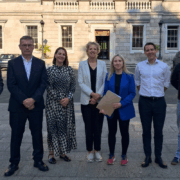
Minister for Justice Jim O’Callaghan TD today launched our latest report, Learning from Survivors of Rape and Sexual Violence – Rape Crisis Statistics 2025, highlighting significant inequalities in survivors’ access to safety, support and justice.
Drawing on data from seven participating Rape Crisis Centres across Ireland, the report found that 32.3% of survivors accessing support in 2025 had characteristics associated with compounded barriers to disclosure and support, including disability, sexual orientation, gender identity, ethnicity or legal status.
The findings reveal a concerning gap in reporting rates. Survivors experiencing two or more compounded barriers were less than half as likely to report sexual violence to a formal authority compared to the overall survivor population. Just 14% of these survivors reported.
Learning from Survivors of Rape and Sexual Violence – Rape Crisis Statistics 2025 was launched at our Beyond the Margins: Sexual Violence, Disability and Other Compounding Barriers event, which brought together policymakers, researchers, advocates and colleagues across the NGO sector to examine the experiences of survivors whose voices are often overlooked. The event also included the launch of Rape Crisis Ireland’s Annual Impact Report 2025 and Rape Crisis Ireland Strategy 2026-2031 – Advocating for Survivors, Preventing Harm: A Strategy for Change.
Minister O’Callaghan said: “While all the RCI reports being launched today make important contributions, what is immediately apparent from the Learning from Survivors report is the demand for specialist services. In 2025 Rape Crisis Centres responded to more than 15,000 helpline contacts, an increase of more than 15% on the previous year. Some 15,800 counselling and support appointments were scheduled, and upwards of 1,400 people engaged in counselling and support services. These figures are stark and provide succinct evidence of the continuing need for specialist services across the country.
“The data also highlights the ways in which different forms of disadvantage and vulnerability may overlap, including that more than a quarter of those whose first experience of sexual violence occurred in mid to later adulthood identified as having a disability. This reinforces the importance of accessibility in its fullest sense – not only physical access, but also communication, service design, and the ability of services to respond appropriately to diverse needs.
“What emerges from these findings is a clear reminder that survivors’ experiences are not uniform. Understanding where barriers exist and how they affect different groups of survivors is essential if we are to build responses that are inclusive and effective. The challenge for all of us is to ensure that no survivor is left behind because of their circumstances, identity or background. That means continuing to strengthen accessibility, improving awareness, and ensuring that services are equipped to respond to the diverse needs of those seeking support.”
The Minister added: “The series of recommendations grounded in the experiences of survivors, contained in the report will be considered as part of ongoing work under the Zero Tolerance Strategy across relevant areas, including the development of the fourth national strategy to combat domestic, sexual, and gender-based violence.”
RCI Executive Director Dr Clíona Saidléar emphasised that the barriers facing many survivors continue long after the violence itself. “Survivors tell us, again and again, that the barriers they face don’t end with the violence itself: they continue in trying to be believed, kept safe, and supported afterwards,” she said.
Dr Saidléar called for a whole-of-system approach that builds independent and accessible routes to disclosure into all residential settings and ensures every safeguarding response is connected directly to specialist trauma support.
RCI Data & Privacy Manager Sally Aquilina explained how our 2025 Statistics Report drew on data captured by Mosaic, our award-winning data collection system, built from the ground up with survivor voices at its core. The combined data allows us to surface the experiences of smaller cohorts, including survivors who face compounded barriers, who would otherwise be invisible in smaller data sets.
A particular focus of Beyond the Margins was the experience of survivors with disabilities, especially those living in residential care settings. Research presented by keynote speakers Dr Rosaleen McDonagh and Dr Lucy Michael highlighted how dependence on services, isolation and a lack of independent reporting mechanisms can create significant barriers to safety and disclosure.
Drawing on their co-authored research for the European Union Agency for Fundamental Rights, Places of Care = Places of Safety? Violence against Persons with Disabilities in Institutions, the speakers explored how violence against disabled people can remain hidden and underreported.
Dr Lucy Michael noted that while research in this area remains limited, the evidence that does exist is deeply concerning. Sexual violence frequently occurs alongside other forms of abuse, while institutional settings can increase vulnerability by separating individuals from family members and support networks.
She highlighted the need for stronger safeguards, including independent investigation mechanisms, confidential reporting channels, disability-rights training for An Garda Síochána and protective measures for those who make complaints. “RCI’s statistics point to a serious gap, and our research gives a glimpse of just how wide that gap can be,” she said.
Dr Rosaleen McDonagh reflected on how violence against disabled people has historically been minimised and overlooked and stressed the importance of including disabled people in research, explicitly asking about experiences of sexual violence, and recognising the intersecting barriers many survivors face.
Challenging assumptions about vulnerability, Dr McDonagh argued that vulnerability is often created by social structures and systems rather than being an inherent characteristic of disabled people.
The findings reinforce one of the central messages emerging from the report: survivors should not have to choose between support specific to their community and specialist trauma support. Survivors deserve both.
Rape Crisis Ireland is calling on Government to embed safeguarding by design across services, ensure frictionless access to specialist trauma support and establish independent, confidential routes to disclosure within the next national strategy on domestic, sexual and gender-based violence.
The message from survivors is clear: hidden barriers require visible, coordinated action. Every survivor deserves an equal right to safety, support and justice, regardless of their background, identity or circumstances.
The slides from our Beyond the Margins event may be viewed here.